
In This Article
- – Quick Answer
- – Secured vs Unsecured Personal Loans: Comparison Table
- – What Is a Secured Personal Loan?
- – Pros and Cons of Secured Personal Loans
- – What Is an Unsecured Personal Loan?
- – Pros and Cons of Unsecured Personal Loans
- – How Much Can You Borrow With Each Loan Type?
- – How Much Does an Unsecured Personal Loan Cost in Singapore?
- – How Do Secured and Unsecured Loans Affect Your Credit?
- – What Happens If You Default?
- – Should You Get a Secured or Unsecured Personal Loan?
- – Frequently Asked Questions
Quick Answer
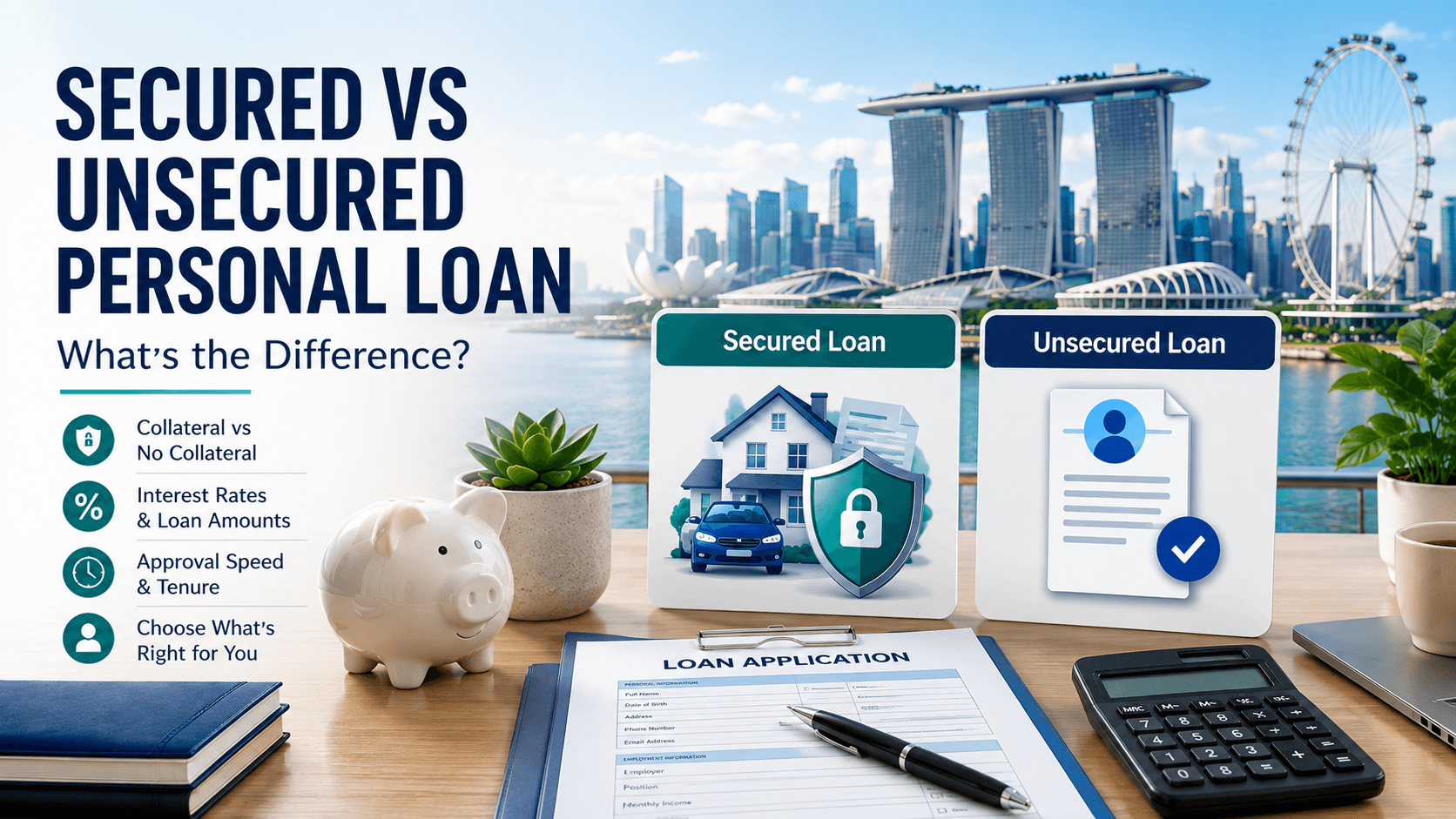
The difference between a secured and an unsecured personal loan is collateral. A secured personal loan requires you to pledge an asset such as property, a vehicle or gold, which the lender can seize if you fail to repay. An unsecured personal loan requires no collateral and is approved based on your income and credit standing. Secured loans cost less and allow larger amounts. Unsecured loans are faster, keep your assets safe, and are what almost every personal loan in Singapore actually is.
Both types of personal loan give you a lump sum that you repay in fixed monthly instalments. The difference lies entirely in what the lender can recover if repayment stops.
With a secured personal loan, you pledge something you own. That reduces the lender’s risk, so you are usually offered a lower interest rate, a larger loan amount and a longer tenure. With an unsecured personal loan, nothing you own is on the line, so the lender prices in that extra risk and relies on your income and credit history instead.
This guide explains what a secured loan is, what an unsecured loan is, the pros and cons of each, how much you can borrow under Singapore law, and which one you should choose.
Secured vs Unsecured Personal Loans: Comparison Table
Here is how secured and unsecured personal loans compare across the factors that matter most to borrowers in Singapore.
| Secured Personal Loan | Unsecured Personal Loan | |
| Collateral required? | Yes. Property, vehicle, fixed deposit, gold or securities | No collateral at all |
| Basis of approval | Value of the asset, plus your ability to repay | Income, employment stability, credit record and existing debt |
| Interest rate | Lower, because the lender’s risk is reduced | Higher, because the lender has no asset to fall back on |
| Loan amount | Larger, determined by the value of the collateral | Smaller, capped by your income under Singapore regulations |
| Approval and funding time | Slower. Valuation and legal documentation are required | Fast. Often approved and disbursed the same working day |
| Typical tenure | Longer, from several years to several decades | Shorter, commonly 6 to 24 months |
| Approval with poor credit | More achievable, as the collateral offsets the risk | Harder, though licensed moneylenders are more flexible than banks |
| Risk to you | Loss of the pledged asset, plus possible shortfall liability | Credit record damage, late charges, collections and legal action |
| Commonly used for | Property, vehicles, large long term financing | Emergencies, medical bills, renovation, debt consolidation |
What Is a Secured Personal Loan?
A secured personal loan is a loan backed by collateral. Collateral is an asset you own that the lender can legally claim and sell if you fail to repay the loan.
When you take a secured loan, the asset remains in your name and you usually continue using it. You still live in the house. You still drive the car. But the lender now holds a registered interest over it, and that interest is only discharged when the final instalment is paid. Until then, you generally cannot sell, transfer or refinance the asset without the lender’s consent.
Because the lender has a guaranteed way to recover its money, it treats you as a lower risk borrower. That is why secured loans typically come with lower interest rates, higher approval odds and larger loan amounts.
How Does a Secured Personal Loan Work?
The process follows a set sequence:
- You apply and nominate the collateral. You tell the lender which asset you intend to pledge.
- The lender values the asset. This may involve a professional valuer for property, a market reference for a vehicle, or an in-house assessment for gold and watches.
- A loan-to-value ratio is applied. No lender advances the full market value. They lend a percentage of it, keeping a buffer in case values fall or a forced sale becomes necessary.
- Legal documentation is prepared. The lender’s interest in the asset is formally registered.
- Funds are disbursed and you repay in fixed monthly instalments.
This is precisely why a secured loan takes longer to fund than an unsecured one. More parties, more paperwork, and more verification of ownership.
What Can Be Used as Collateral for a Secured Loan in Singapore?
The assets Singapore lenders commonly accept as collateral are:
- Residential or commercial property
- Motor vehicles
- Fixed deposits, shares and unit trusts
- Gold, jewellery and luxury watches
- The cash value of a participating life insurance policy
One point worth clarifying, because it is a frequent question: CPF savings cannot be used as collateral for a personal loan. CPF monies are legally protected and cannot be assigned to a lender.
Types of Secured Loans in Singapore
| Secured Loan Type | Collateral Used | Key Feature |
| Home loan or mortgage | The property itself | Largest and longest secured loan available |
| Car loan or hire purchase | The vehicle | Financier holds an interest until final payment |
| Pawnbroking | Gold, jewellery, luxury watches | Interest capped at 1.5% per month, six month redemption period |
| Secured overdraft or share financing | Fixed deposits or securities | Draw down against pledged investments |
| Policy loan | Insurance policy cash value | Borrow against accumulated value |
Pros and Cons of Secured Personal Loans
Pros of a Secured Loan
- Lower interest rate. Collateral reduces the lender’s exposure, and that saving is passed on to you.
- Larger loan amount. The ceiling is set by what your asset is worth, not by your monthly salary.
- Longer repayment tenure. Spreading the loan over more years reduces the monthly instalment.
- Easier approval with weak credit. If your credit history is thin or damaged, the collateral does the reassuring that a strong credit file would otherwise do.
Cons of a Secured Loan
- You can lose the asset. This is not theoretical. Pawned items are forfeited, vehicles are repossessed, and properties are sold in enforcement.
- You may still owe money after losing it. If the sale proceeds do not cover the outstanding balance, you can be pursued for the shortfall.
- Slow to fund. Valuation and legal work take days or weeks, which is useless in an emergency.
- Extra upfront costs. Valuation fees, legal fees and insurance requirements add to the total.
- The asset stays tied up. You cannot freely sell or refinance it until the loan is settled.
What Is an Unsecured Personal Loan?
An unsecured personal loan is a loan granted without any collateral. Nothing you own is pledged, no claim is registered against your name, and no asset is at risk under the loan agreement.
Instead of relying on an asset, the lender relies on evidence that you can and will repay. Because there is no fallback, the lender examines your financial profile far more closely and prices the loan higher to reflect the additional risk it is carrying.
In Singapore, the overwhelming majority of personal loans are unsecured. Bank personal loans, credit lines, credit cards and licensed moneylender loans all fall into this category.
How Does an Unsecured Personal Loan Work?
The lender assesses you rather than your possessions. A typical assessment looks at:
- Your monthly income and how stable it is
- Your length of employment, or your business track record if self-employed
- Your credit record with the relevant credit bureau
- Your existing loan commitments and monthly obligations
- How much unsecured credit you already hold across all lenders
From that picture, the lender determines an amount you can comfortably service, sets a tenure and quotes a rate. Since there is no valuation and no legal registration of security, the timeline compresses dramatically. A licensed moneylender can often complete assessment, approval and disbursement within the same working day.
Types of Unsecured Loans in Singapore
- Personal loans from banks and licensed moneylenders, usable for any purpose
- Credit lines and cashline facilities, where standby funds sit ready to draw
- Credit cards and card instalment plans
- Renovation and wedding loans, which are unsecured despite being purpose-marketed
- Balance transfers and debt consolidation plans
Learn more: An easy guide to unsecured loans in Singapore
Pros and Cons of Unsecured Personal Loans
Pros of an Unsecured Loan
– No collateral required. Your home, car and savings stay entirely outside the agreement.
– No risk of asset seizure. Even if repayment goes wrong, there is nothing for the lender to take.
– Fast approval and disbursement. Often same day, which is what makes it viable for emergencies.
– Minimal documentation. Usually NRIC or work pass, income proof, CPF contribution history and proof of address.
– Complete freedom of use. No restriction tying the money to a specific purchase.
– Cost is capped by law. For licensed moneylender loans, statutory limits cap what you can ever be charged.
Cons of an Unsecured Loan
– Higher interest rate. You pay for the fact that the lender has no security.
– Lower borrowing ceiling. Your income, not your assets, sets the maximum.
– Shorter tenure. A compressed repayment period means larger monthly instalments.
– Approval depends on your profile. Unstable income or a poor credit record directly reduces the amount approved.
How Much Can You Borrow With a Secured vs Unsecured Loan in Singapore?
This is where Singapore differs sharply from other markets, and where most international guides give you the wrong answer.
Secured loans have no statutory quantum cap. The amount depends entirely on the value of your collateral and your ability to service the repayments. This is why property financing runs into hundreds of thousands of dollars.
Unsecured loans from licensed moneylenders are capped by regulation. The Registry of Moneylenders under the Ministry of Law sets these limits:
| Borrower | Annual Income | Maximum Unsecured Loan |
| Singapore Citizen or PR | Below S$20,000 | S$3,000 |
| Borrower | Annual Income | Maximum Unsecured Loan |
| Singapore Citizen or PR | S$20,000 and above | 6 times monthly income |
| Foreigner residing in Singapore | Below S$10,000 | S$500 |
| Foreigner residing in Singapore | S$10,000 to below S$20,000 | S$3,000 |
| Foreigner residing in Singapore | S$20,000 and above | 6 times monthly income |
Two things borrowers routinely get wrong about this cap:
It is aggregate, not per lender. The limit applies to your total outstanding principal across every licensed moneylender combined, tracked through the Moneylenders Credit Bureau. Approaching a second lender does not give you a fresh ceiling.
A wider limit sits above it. The Monetary Authority of Singapore applies an industry-wide unsecured borrowing limit of 12 times monthly income across banks and financial institutions.
How Much Does an Unsecured Personal Loan Cost in Singapore?
Unsecured borrowing from a licensed moneylender carries a higher rate than a secured loan, but the cost is not open-ended. Under the Moneylenders Act 2008, these limits apply:
| Charge | Statutory Maximum |
| Interest | 4% per month |
| Late interest | 4% per month, on the overdue amount only |
| Administrative fee | 10% of the principal, charged once on approval |
| Late payment fee | S$60 per month |
| Total charges (interest, late interest and all fees) | Cannot exceed the principal amount |
That final line is the strongest borrower protection in the framework. Borrow S$5,000 and the absolute maximum you can ever be charged on top of the principal is S$5,000, regardless of how long the loan runs or how badly repayment goes.
Any lender charging beyond these caps is operating illegally.
Learn more: How to avoid loan sharks in Singapore
How Do Secured and Unsecured Loans Affect Your Credit?
Both types of loan are recorded and both affect your borrowing profile, but through different bureaus.
Loans from licensed moneylenders are reported to the Moneylenders Credit Bureau (MLCB), which tracks your outstanding balances and repayment conduct across all licensed moneylenders. Bank loans and credit cards are reported to Credit Bureau Singapore (CBS), which generates the credit score banks use to assess you.
Paying either type of loan on time builds a positive repayment record that improves your standing for future applications. Missing payments does the reverse, and the record persists.
The important asymmetry is this. If you default on a secured loan, you face a double penalty: the lender seizes your collateral and reports the default. If you default on an unsecured loan, the damage is confined to your credit record and the recovery process, with no asset lost.
What Happens If You Default on a Secured or Unsecured Loan?
If you default on a secured loan, the lender enforces directly against the collateral. A pawnbroker forfeits the pledged item once the redemption period lapses. A financier repossesses the vehicle. A mortgagee moves toward a forced sale. And critically, if the sale proceeds do not clear the full outstanding balance, you can still be pursued for the shortfall. Losing the asset does not automatically end the debt.
If you default on an unsecured loan, there is nothing to seize, but the consequences are still real. Late interest and late fees accrue within the statutory caps. The default is recorded with the relevant credit bureau, affecting future applications for loans, credit cards and in some cases employment screening in financial roles. Sustained non-payment can escalate to a civil claim and, in the most serious cases, bankruptcy proceedings.
Unsecured does not mean consequence-free. It means the consequence falls on your credit standing rather than on an asset you depend on today.
Should You Get a Secured or Unsecured Personal Loan?
The right choice depends on what you need the money for, how fast you need it, and what you can afford to risk.
When to Consider a Secured Personal Loan
– You are buying the asset itself. Property and vehicle purchases are financed through secured lending, full stop.
– You need a large sum. Anything well beyond six times your monthly income requires collateral.
– You want the lowest possible interest rate and you have time to wait for approval.
– Your credit history is weak but you own substantial assets. The collateral can unlock funding that an unsecured application would not.
– You are confident about long term repayment stability. Because the downside is losing the asset.
When to Consider an Unsecured Personal Loan
– You need funds urgently. Same-day disbursement is only possible without collateral.
– You need a moderate amount. Anything within six times your monthly income is well served.
– You have no asset to pledge, or the asset you own is too important to risk.
– You want flexibility. Medical bills, school fees, renovation, a wedding or a cash flow gap all qualify.
– You cannot accept the risk of losing your home or car under any circumstances.
A practical rule to apply before you sign: if losing the collateral would damage your household or end your ability to earn, the lower interest rate on a secured loan is not a saving. It is a risk you simply have not priced yet.
Where to Get an Unsecured Personal Loan in Singapore
Banks price unsecured personal loans lower, but they apply higher income thresholds, stricter credit checks and longer processing times. Licensed moneylenders serve the space in between: smaller sums, faster turnaround, and assessment criteria that accommodate borrowers whom banks decline for reasons unrelated to their actual ability to repay.
SGP Credit provides unsecured personal loans to Singaporeans, PRs and foreigners working here, with repayment schedules built around your pay cycle. For company funding, we also offer business loans, SME loans and working capital loans.
Before borrowing from any moneylender, check the company against the official list of licensed moneylenders. A licensed lender must meet you in person at an approved place of business, explain the contract terms, give you a copy of the note of contract, and will never request payment before disbursing your loan.
Frequently Asked Questions
Q. Is a personal loan secured or unsecured?
A. In Singapore, personal loans are almost always unsecured. Bank personal loans, credit lines and licensed moneylender loans do not require collateral. Secured personal loans exist but are far less common and are generally arranged through banks against property or investments.
Q. Which is better, a secured or unsecured loan?
A. Neither is universally better. A secured loan is better when you need a large sum over a long period and can safely pledge an asset. An unsecured loan is better when you need money quickly, need a moderate amount, or cannot risk losing an asset.
Q. Can I get an unsecured personal loan with bad credit in Singapore?
A. Yes, though the approved amount may be lower. Licensed moneylenders assess your current income and repayment capacity rather than relying on a credit score alone, which is often why an application succeeds here after a bank rejection.
Q. Is a secured loan always cheaper than an unsecured loan?
A. The headline interest rate is almost always lower. However, valuation fees, legal fees and insurance requirements can erase that advantage on smaller or shorter loans. Compare the total cost, not just the rate.
Q. Can a moneylender take my property if I default on an unsecured loan?
A. No. Without a security agreement there is no charge over any asset you own. The lender’s recourse is collections and civil legal action within the limits set by the Moneylenders Act.
Q. How much can I borrow on an unsecured loan in Singapore?
A. If your annual income is S$20,000 or more, up to six times your monthly income across all licensed moneylenders combined. If it is below S$20,000, the cap is S$3,000 for citizens and PRs.
Q. Does repaying an unsecured loan early reduce the interest?
A. That depends on how interest is calculated in your contract. Always ask for the early settlement position in writing before signing. Our FAQ page explains how this works with our loans.
The Bottom Line
The difference between a secured and unsecured personal loan comes down to one thing: whether an asset is on the line.
A secured loan trades your risk for a better price. You accept that collateral can be seized, and in return you receive a lower rate, a larger sum and a longer tenure. That trade makes sense when the loan is buying the asset itself or funding something genuinely large.
An unsecured loan trades price for protection. You pay more, but your home, car and savings stay entirely outside the agreement, and with a licensed moneylender the maximum cost is fixed by law before you sign.
For most households in Singapore needing anywhere from a few thousand dollars to several months of salary, an unsecured personal loan from a licensed lender is the appropriate choice. Secured borrowing belongs to property, vehicles and long horizon financing.
To find out exactly what you qualify for and what it will cost in total, apply online or speak to our team at our Jurong East office. SGP Credit is a licensed moneylender regulated by the Ministry of Law, and there are no figures you will discover only after signing.
