
Secured vs Unsecured Personal Loan: What Is the Difference?
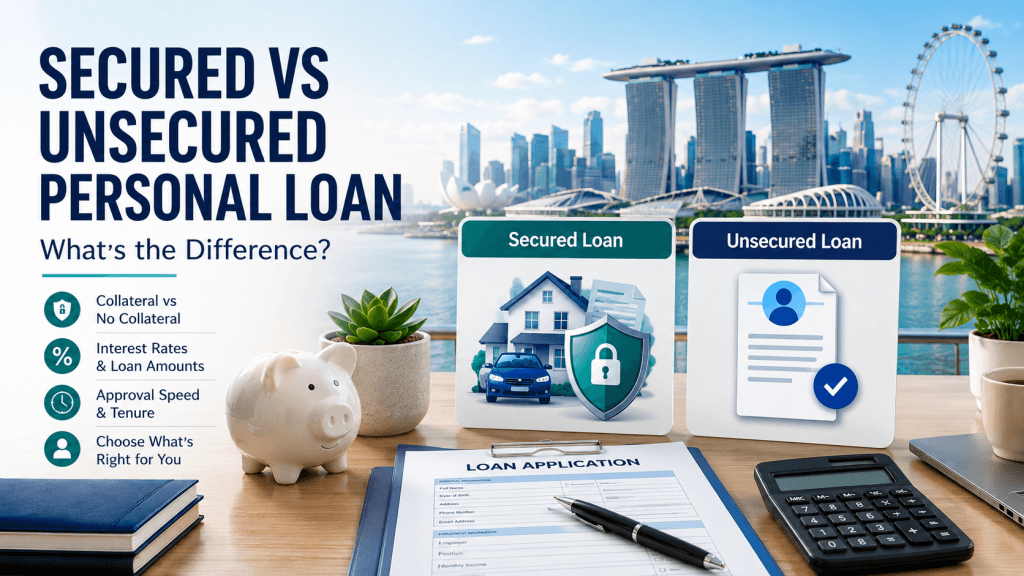
In This Article – Quick Answer – Secured vs Unsecured Personal Loans: Comparison Table – What Is a Secured Personal Loan? – Pros and Cons of Secured Personal Loans – What Is an Unsecured Personal Loan? – Pros and Cons of Unsecured Personal Loans – How Much Can You Borrow With Each Loan Type? – How Much Does an Unsecured Personal Loan Cost in Singapore? – How Do Secured and Unsecured Loans Affect Your Credit? – What Happens If You Default? – Should You Get a Secured or Unsecured Personal Loan? – Frequently Asked Questions Quick Answer The difference between a secured and an unsecured personal loan is collateral. A secured personal loan requires you to pledge an asset such as property, a vehicle or gold, which the lender can seize if you fail to repay. An unsecured personal loan requires no collateral and is approved based on your income and credit standing. Secured loans cost less and allow larger amounts. Unsecured loans are faster, keep your assets safe, and are what almost every personal loan in Singapore actually is. Both types of personal loan give you a lump sum that you repay in fixed monthly instalments. The difference lies entirely in what the lender can recover if repayment stops. With a secured personal loan, you pledge something you own. That reduces the lender’s risk, so you are usually offered a lower interest rate, a larger loan amount and a longer tenure. With an unsecured personal loan, nothing you own is on the line, so the lender prices in that extra risk and relies on your income and credit history instead. This guide explains what a secured loan is, what an unsecured loan is, the pros and cons of each, how much you can borrow under Singapore law, and which one you should choose. Secured vs Unsecured Personal Loans: Comparison Table Here is how secured and unsecured personal loans compare across the factors that matter most to borrowers in Singapore. Secured Personal Loan Unsecured Personal Loan Collateral required? Yes. Property, vehicle, fixed deposit, gold or securities No collateral at all Basis of approval Value of the asset, plus your ability to repay Income, employment stability, credit record and existing debt Interest rate Lower, because the lender’s risk is reduced Higher, because the lender has no asset to fall back on Loan amount Larger, determined by the value of the collateral Smaller, capped by your income under Singapore regulations Approval and funding time Slower. Valuation and legal documentation are required Fast. Often approved and disbursed the same working day Typical tenure Longer, from several years to several decades Shorter, commonly 6 to 24 months Approval with poor credit More achievable, as the collateral offsets the risk Harder, though licensed moneylenders are more flexible than banks Risk to you Loss of the pledged asset, plus possible shortfall liability Credit record damage, late charges, collections and legal action Commonly used for Property, vehicles, large long term financing Emergencies, medical bills, renovation, debt consolidation What Is a Secured Personal Loan? A secured personal loan is a loan backed by collateral. Collateral is an asset you own that the lender can legally claim and sell if you fail to repay the loan. When you take a secured loan, the asset remains in your name and you usually continue using it. You still live in the house. You still drive the car. But the lender now holds a registered interest over it, and that interest is only discharged when the final instalment is paid. Until then, you generally cannot sell, transfer or refinance the asset without the lender’s consent. Because the lender has a guaranteed way to recover its money, it treats you as a lower risk borrower. That is why secured loans typically come with lower interest rates, higher approval odds and larger loan amounts. How Does a Secured Personal Loan Work? The process follows a set sequence: You apply and nominate the collateral. You tell the lender which asset you intend to pledge. The lender values the asset. This may involve a professional valuer for property, a market reference for a vehicle, or an in-house assessment for gold and watches. A loan-to-value ratio is applied. No lender advances the full market value. They lend a percentage of it, keeping a buffer in case values fall or a forced sale becomes necessary. Legal documentation is prepared. The lender’s interest in the asset is formally registered. Funds are disbursed and you repay in fixed monthly instalments. This is precisely why a secured loan takes longer to fund than an unsecured one. More parties, more paperwork, and more verification of ownership. What Can Be Used as Collateral for a Secured Loan in Singapore? The assets Singapore lenders commonly accept as collateral are: Residential or commercial property Motor vehicles Fixed deposits, shares and unit trusts Gold, jewellery and luxury watches The cash value of a participating life insurance policy One point worth clarifying, because it is a frequent question: CPF savings cannot be used as collateral for a personal loan. CPF monies are legally protected and cannot be assigned to a lender. Types of Secured Loans in Singapore Secured Loan Type Collateral Used Key Feature Home loan or mortgage The property itself Largest and longest secured loan available Car loan or hire purchase The vehicle Financier holds an interest until final payment Pawnbroking Gold, jewellery, luxury watches Interest capped at 1.5% per month, six month redemption period Secured overdraft or share financing Fixed deposits or securities Draw down against pledged investments Policy loan Insurance policy cash value Borrow against accumulated value Pros and Cons of Secured Personal Loans Pros of a Secured Loan Lower interest rate. Collateral reduces the lender’s exposure, and that saving is passed on to you. Larger loan amount. The ceiling is set by what your asset is worth, not by your monthly salary. Longer repayment tenure. Spreading the loan over more years reduces the monthly instalment. Easier approval with weak credit. If your