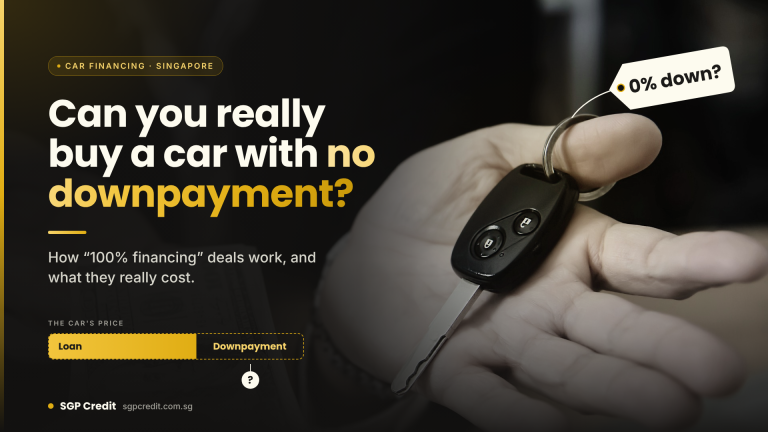
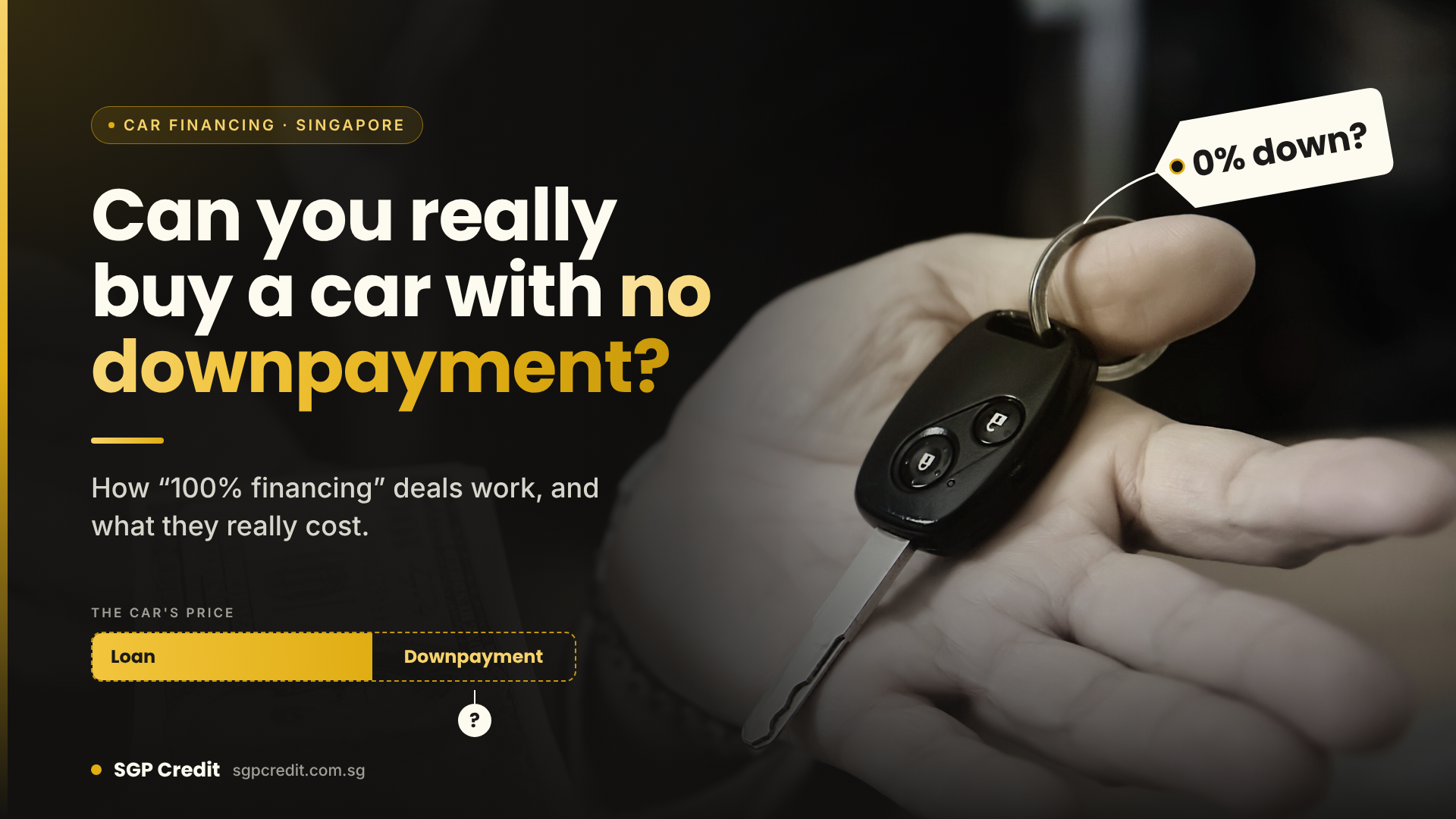
The ad usually turns up between other posts: a clean sedan, a smiling salesperson and “S$0 down” in large letters. Then you speak to a bank and hear a very different number. On a S$150,000 car, the down payment can be S$60,000 in cash.
Neither tells the whole story. Through a regulated car loan, you can’t drive off with nothing down. The “0% down payment” offers exist because they’re built outside those loan rules, or around them. Some are simply expensive. Others leave you with fewer protections than you’d expect. Below, we take the sales pitch apart line by line, then put the numbers side by side.
Why the down payment is so big in the first place
Banks, finance companies, and merchant banks must follow MAS’s motor vehicle loan rules. If a car’s open market value (OMV) is S$20,000 or less, they can lend up to 70% of the purchase price. Above that, the limit is 60%. Either way, the loan can’t run for more than seven years.
Those two numbers do different jobs. The OMV only decides which limit applies. The limit is then applied to the purchase price, which includes the COE and relevant taxes, and that’s why the cash gap grows so quickly. For a S$150,000 car with an OMV above S$20,000, the most a bank can lend is S$90,000. The other S$60,000 is on you.
A few vehicles sit outside these rules. Motorcycles and commercial vehicles are exempt. There’s also a separate exemption for persons with physical disabilities and eligible caregivers, who can apply for financing of up to 100% over as long as ten years for one vehicle, subject to eligibility and the lender’s assessment.
For everyone else, a “no down payment” offer has to come from somewhere else.
What the showroom pitch really means
These offers aren’t hard to find. In a Straits Times investigation published on 1 March 2026, four of the five dealers the paper contacted indicated they could arrange 100% financing. Only one advised caution. Here are the lines you’re likely to hear, and what usually sits behind each one.
We can do the full amount in-house.
The dealer arranges the financing itself, rather than sending you to a bank or finance company. That changes more than the paperwork. The Ministry of Transport told Parliament on 15 October 2025 that leasing and lease-to-own schemes from car dealers that aren’t structured as hire purchase are not regulated by MAS.
So the first question is simple: who is lending you the money, and is this a hire-purchase agreement, a loan,n or a lease? The answer decides which protections you’ll have later.
We’ll put a higher price on the invoice so the bank covers more.
This one uses a regulated bank loan, but at a price that isn’t real. The Straits Times gave the example of a S$120,000 car invoiced at S$170,000, so a percentage-based loan ends up covering most of the actual price. The paper reported that overstating a price this way can expose both buyer and seller to allegations of fraud or deception. It also quoted MAS as expecting lenders to check that purchase prices are reasonable, for example through independent valuations.
If the invoice doesn’t match what you’re really paying, don’t sign it.
Register it as a private-hire car, and the limits won’t apply.
The Straits Times described private-hire cars as falling outside the ordinary financing restrictions, which is why some deals are routed through that registration. Before agreeing, ask exactly what registering the car that way commits you to, and get the answer in writing.
It’s lease-to-own. The car’s yours at the end.
You’d be paying to use the car, and whether and when it becomes yours depends entirely on the contract. The risk people rarely factor in is the company on the other side.
In January 2026, CNA reported that Autobahn Rent A Car had suspended its rental operations while owing more than S$300 million as of 23 December 2025. Drivers faced disruption as vehicles were repossessed. One driver told CNA that a S$500 deposit hadn’t been returned and the car’s road tax had expired. CNA also reported that more than 220 car-leasing firms closed in 2025.
Ask whose name the car will be registered in, and what happens to the money you’ve paid if the company fails.
It’s only S$1,585 a month.
A low monthly figure often comes from stretching the loan, and stretching costs money. That’s easiest to see with numbers.
Three ways to pay for the same S$150,000 car
The table compares the regulated route with two 100% financing setups. To keep the comparison fair, every column uses the same flat rate: 2.68% a year, the seven-year car loan rate DBS published when we checked. Real dealer quotes may use different rates and add fees, so treat this as an illustration, not an offer.
| Bank loan with down payment | 100% financed over 7 years | 100% financed over 10 years | |
|---|---|---|---|
| Cash upfront | S$60,000 | S$0 | S$0 |
| Amount borrowed | S$90,000 | S$150,000 | S$150,000 |
| Monthly instalment | S$1,272 | S$2,121 | S$1,585 |
| Total interest | S$16,884 | S$28,140 | S$40,200 |
| Total paid, including cash | S$166,884 | S$178,140 | S$190,200 |
| Extra cost vs bank loan | — | S$11,256 | S$23,316 |
| Effective interest rate | 5.01% | 5.01% | 4.92% |
Illustrative only. Same flat rate in every column, fees excluded.
Look at the two right-hand columns. Stretching a fully financed loan from seven years to ten cuts the instalment by about S$536 a month and adds S$12,060 in interest. Compared with putting cash down, the ten-year deal costs S$23,316 more before a single fee is added.
The effective rate row looks odd at first. The ten-year deal has the lowest effective rate of the three, yet it costs the most, because you’re borrowing more money for longer. Flat rates make this hard to spot. Interest is worked out on the original amount for the whole term (principal × flat rate × years), even as you pay the balance down, so the effective rate ends up higher than the headline rate. DBS’s own example pairs 2.68% flat with 5.01% effective, which matches what our calculation gives for the bank column.
Whatever you’re offered, ask for both rates, the total amount payable and every fee in writing.
Who protects you if the deal goes wrong
A 0% down payment deal isn’t illegal just because it’s 0%. But once it sits outside MAS’s car loan rules, your protection depends on what kind of agreement you’ve signed.
The Hire-Purchase Act gives the clearest framework for the agreements it covers. A regulated hire-purchase agreement has to show the cash price including COE, the applied and effective interest rates, the instalments, total interest, fees, the total amount payable, and how early settlement is worked out. The catch is scope. For motor vehicles, the Act’s definition of a regulated agreement has a value threshold of S$55,000, including GST and import and excise duties but excluding the COE. Check whether yours is covered before you rely on it.
Consumer protection law still applies to the dealer. The Consumer Protection (Fair Trading) Act covers motor-vehicle dealers and conduct that could reasonably deceive or mislead. Under the Misrepresentation Act, a buyer who was misled may be able to set the contract aside or claim damages, although a court can award damages instead of cancelling the contract.
CASE, the Consumers Association of Singapore, offers advice and mediation. Its CaseTrust-SVTA scheme gives access to the Motor Industries Dispute Resolution Centre (MIDReC) for eligible disputes with participating motoring businesses.
Tighter rules may come. The Ministry of Transport told Parliament on 4 February 2026 that the Government is monitoring problematic financing arrangements and may tighten regulations if necessary. That’s a warning, though, not a new rule, and it won’t change a contract you sign today.
When the payments start slipping
Under a regulated hire-purchase agreement, the owner has to serve a prescribed notice of intention to repossess. Once the car is taken, it must be kept for seven business days. During that time, you can give written notice asking for it back, then reinstate the agreement by paying the specified arrears and costs within the applicable period. Or you can finalise the agreement by paying the balance and costs. If you do neither, you may be liable for the owner’s loss, and you’re owed a refund if the car is worth more than that.
Outside the Act, the contract sets the terms. Whether missed payments show up on your credit report depends on whether the provider reports to Credit Bureau Singapore, the Moneylenders Credit Bureau, or neither.
Then there’s the gap nobody mentions at the showroom. If the car is written off, or sold while the debt is still high, the insurance payout or sale price may not cover what you owe. You may still have to pay the difference.
If a relative has asked you to be their guarantor, read the guarantee itself. What you’d owe depends on its terms and the agreement behind it, not on what anyone told you at the dealership.
Already signed? Two ways out, and their limits
Refinancing. Eligible motor vehicle loans can be refinanced with a bank or finance company under MAS’s refinancing rules, up to the full outstanding amount and subject to the lender’s credit assessment. The maximum tenure is generally seven years minus the years since the loan was first disbursed. Not every dealer arrangement qualifies, so ask for your current settlement figure before you start.
Trading in. A trade-in doesn’t automatically clear the old loan. If the trade-in value is below what you still owe, the shortfall may be yours to pay. Before you sign for the next car, get the settlement figure from your lender and written confirmation of how and when the old loan will be paid off.
Cheaper ways to get on the road
Most of the safer options come down to more cash upfront or a less expensive car. Saving towards the down payment keeps you inside regulated lending. Choosing a car with an OMV of S$20,000 or less moves you from the 60% limit to 70%, so the minimum down payment drops from 40% to 30%.
A used car can help, though not always by as much as its price tag suggests. Lenders work from an adjusted OMV that falls as the car ages. For a car imported into Singapore as new, that’s the OMV minus (age in months ÷ 120 × OMV). How much you can borrow then depends on that figure and the lender’s assessment.
If you only need a car for a while, renting on clear terms may suit you better than a lease-to-own contract you don’t fully understand. And CPF won’t fill the gap. Its published permitted uses cover housing, retirement, healthcare, education and investment, and buying a car isn’t among them.
What about borrowing the down payment from a licensed moneylender?
That isn’t a way around the limits. Under the Ministry of Law’s licence conditions dated 1 April 2026, a licensed moneylender granting a loan to buy a motor vehicle must comply with MAS Notice 642, the same loan-to-value and tenure rules that banks follow. Licensed moneylenders are regulated by the Registry of Moneylenders, Ministry of Law, not by MAS.
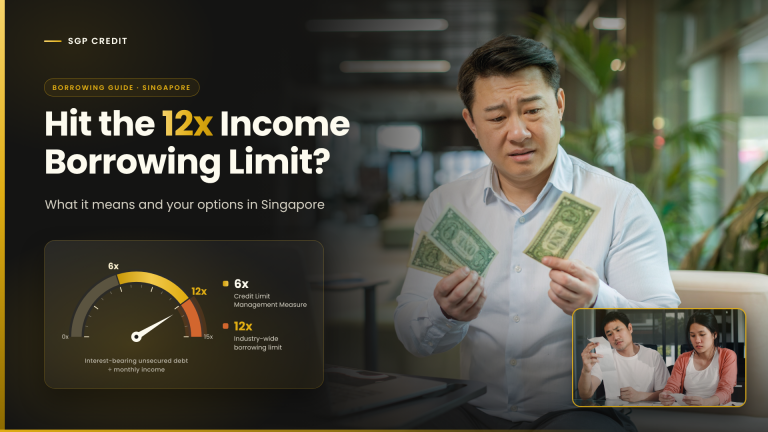
Rules aside, a separate loan for the down payment means paying off two debts for one car. Unsecured borrowing from licensed moneylenders is also capped by income, and our guide to the 12x income limit sets those caps out. If the instalments on the car alone would stretch your budget, a cheaper car or a few more months of saving will cost you less than borrowing twice.
Thinking about a personal loan for something else? SGP CREDIT SINGAPORE PTE. LTD. is licensed by the Ministry of Law’s Registrar of Moneylenders (Licence No. 10/2026). Our team can explain what a loan would cost you in total and how repayments would work before you decide. Approval is subject to our assessment of your income, existing loans,s and repayment ability.
133, JURONG GATEWAY ROAD, #01-295, SINGAPORE 600133 · Tel: 6466 1157
Before dealing with any moneylender, you can confirm its licence on the Ministry of Law’s list of licensed moneylenders.
Sources
- Monetary Authority of Singapore — Rules for motor vehicle loans, including exemptions, used-car valuation and refinancing
- Ministry of Law, Registry of Moneylenders — licence conditions dated 1 April 2026 (rom.mlaw.gov.sg); list of licensed moneylenders
- Ministry of Transport — written reply on 100% financing packages, 15 October 2025
- Ministry of Transport — written reply on car-leasing defaults and financing practices, 4 February 2026
- Singapore Statutes Online — Hire-Purchase Act 1969; Consumer Protection (Fair Trading) Act and Misrepresentation Act (sso.agc.gov.sg)
- Consumers Association of Singapore (CASE) — consumer advice, mediation and the CaseTrust-SVTA scheme
- CPF Board — permitted uses of CPF savings
- The Straits Times — Concerns over 100 per cent borrowing for vehicles as outstanding car loans hit a 12-year high, 1 March 2026
- CNA — Autobahn Rent A Car suspends vehicle rental business as debts mount; More than 220 car leasing firms closed in 2025, January 2026
- DBS — Car loan promotion