
Waiting for an EDGE Grant Payout: How Singapore SMEs Can Bridge the Cash Flow Gap
The EDGE grant pays Singapore businesses back after a project is finished, not before it starts. A company must complete the approved activity and pay its vendor in full before it can claim, so the entire cost comes out of the business first. Five sources can cover that gap: cash reserves, vendor payment terms, a bank working capital loan or Enterprise Financing Scheme (EFS) facility, a bank overdraft, or a business loan from a licensed moneylender. EDGE is also new. Enterprise Singapore’s Productivity Solutions Grant (PSG), Enterprise Development Grant (EDG) and Market Readiness Assistance (MRA) ceased on 29 September 2026, and new business grant applications have gone through EDGE since 30 September 2026. Existing PSG, EDG and MRA submissions and projects are not converted to EDGE; they continue to be processed and can be claimed once completed. EDGE grants are paid only after the work is done and paid for The EDGE grant works on a reimbursement basis, so Enterprise Singapore pays nothing upfront. As of October 2026, a company claims once the activity is completed and full payment has been made, and each approved project gets one final claim. Until that claim is paid, the business carries the whole cost. Timing matters before approval too. If work starts, or any payment or deposit goes to a supplier, vendor, or third party, before the application is submitted, Enterprise Singapore treats the application as retrospective and won’t support it. Paying after submission but before approval may be supported if the application is approved, but until then the risk sits with the business. Support depends on the activity, within an annual cap EDGE support levels vary by activity. As of October 2026, Enterprise Singapore’s EDGE FAQ puts the highest support, up to 70% for SMEs and up to 50% for non-SMEs, on internationalisation and sustainability activities, so check the level for your own activity. Each company can receive up to S$100,000 in EDGE support a year across all its activities, and the cap refreshes every 1 April. Up to S$30,000 of that can go to single-function digital solutions, integrated enterprise systems and selected automation activities. EDGE is open to Singapore-registered businesses with local ownership To apply for EDGE, a business must be registered in Singapore with at least 30% Singaporean or permanent resident (PR) ownership, as of October 2026. Non-SMEs can receive support too, at lower maximum levels. The gap runs from the vendor payment to the final payout For an EDGE project, the cash flow gap opens when the business pays its vendor and closes when the claim is paid out. A typical sequence runs like this: Submit the EDGE application. Don’t start work or pay anything before this. Receive approval. Paying between submission and approval is at the business’s own risk. Complete the activity and pay the vendor in full. Submit the single, final claim before the claim due date. Wait for the claim to be approved and paid. As of October 2026, Enterprise Singapore’s EDGE pages don’t set a fixed payout time after a claim is approved. Plan around a range rather than a date, and ask Enterprise Singapore what to expect for your activity. Paying the vendor in instalments stretches the gap further, because the claim can’t go in until the last instalment clears. Five sources can cover the cost until the grant arrives With the timeline in view, the next decision is how to fund it. Each of the five sources affects the claim timeline and the total cost differently. Vendor terms spread the cost but hold up the claim. Loans and overdrafts leave the timeline alone but add interest and fees. Option Provided by Effect on when you can claim Points to check Cash reserves The business itself No delay Enough cash left for wages, rent and suppliers Vendor payment terms The vendor, as a commercial term Delayed until the final payment Whether instalments are offered, and the final payment date Bank working capital loan or EFS facility Banks, or participating financial institutions under Enterprise Singapore’s EFS risk-sharing scheme No delay The lender’s assessment and the total cost Bank overdraft A bank No delay The limit, the fees and how the facility is reviewed Business loan from a licensed moneylender A licensed moneylender, regulated by the Registry of Moneylenders, Ministry of Law No delay The monthly interest rate and every fee, in writing Vendors and third parties must not pay on the company’s behalf Enterprise Singapore’s EDGE rules say the applicant company should apply and make payment for the project, and that vendors or third parties must not apply, submit claims or make payment on its behalf (as of October 2026). For a project funded by a loan, the simplest structure keeps the company as the payer: the loan goes into the company’s own bank account, and the company pays the vendor. If a lender or financier offers to pay your vendor directly, ask Enterprise Singapore whether that counts as a third-party payment before you agree, and get the answer in writing. Business loans from licensed moneylenders follow their own rules Business loans from licensed moneylenders in Singapore are treated differently from other loans under the Moneylenders Rules. As of October 2026, the 4% monthly interest cap, the 4% monthly late-interest cap and the rule that total charges cannot exceed the principal (the amount borrowed) do not apply to business loans. Interest is still calculated on the principal outstanding each month. The Rules define a business loan to include a loan to a company, a limited liability partnership (LLP), or a person registered under the Business Names Registration Act, where the business has been carried on for at least one year. A sole proprietorship that meets these conditions qualifies. Fees differ too. The 10% administrative fee cap and the S$60 monthly late fee cap apply to loans other than business loans. Business loans have their own list of permitted fees, including a late repayment fee and, for term loans (loans repaid over a fixed period),
How to Check If a Moneylender Is Licensed in Singapore: 6 Checks to Spot Loan Scams
A loan offer that lands on WhatsApp when money is tight can feel like help has arrived. It can also be the start of a scam. The Registry of Moneylenders warns that scammers impersonate licensed moneylenders over SMS and WhatsApp, so a company name you recognise proves very little on its own. To check if a moneylender in Singapore is licensed, look it up on the Ministry of Law’s List of Licensed Moneylenders and confirm that the business name, licence number, address, phone number and website all match. Then watch how the lender behaves. Licensed moneylenders must follow strict rules on advertising, fees and your personal documents, and a lender that breaks those rules is a warning sign. This guide sets out six checks to make before you borrow. It then explains what a licensed moneylender can legally charge, and what to do if you are struggling to repay or have already been scammed. Licensed moneylender or Ah Long: why the difference matters A licensed moneylender in Singapore holds a licence from the Registry of Moneylenders, Ministry of Law (MinLaw), and must follow the Moneylenders Act and Rules. Those rules cap the interest, fees, and amounts a licensed moneylender can lend. They also set out how the lender must treat you, from explaining the contract to recovering a debt. An Ah Long is an unlicensed moneylender. The Singapore Police Force notes that unlicensed moneylenders are also known as “loansharks” or “Ah Longs”. An Ah Long works outside the licensing system that sets those caps and protections. As of September 2026, unlicensed moneylending can be reported on the Police Hotline at 1800-255-0000. 6 checks to make before you borrow Run through these six checks before you share any documents or sign anything. Each one is based on rules set by the Registry of Moneylenders or guidance from the Singapore Police Force and ScamShield. 1. Find the lender on MinLaw’s list Start with the List of Licensed Moneylenders, published by the Registry of Moneylenders. As of September 2026, the list shows each licensed moneylender’s business name, licence number, address, telephone number and website. It was last updated on 23 September 2026. If you cannot find the business on the list, stop there. 2. Match every detail, not just the name Because scammers use the names of real companies, a matching name is not enough. Compare the licence number, address, phone number, and website with the list exactly. If the name matches but the phone number is different, treat it as a warning sign. Call the number shown on the Registry’s list, not the one that contacted you. 3. Notice how the lender reached you Licensed moneylenders in Singapore can advertise in only a few places. As of September 2026, the Registrar’s Directions on advertising (Version 3.0, effective 1 April 2025) allow three channels: business or consumer directories in print or online, the lender’s own website, and inside or on the exterior of its approved place of business. Promotional advertising by SMS, WhatsApp, WeChat, email, and on social media such as Facebook is prohibited. The Singapore Police Force also names Telegram, TikTok and Instagram. A licensed moneylender may still contact its existing customers about outstanding loans, but a loan offer you never asked for is a red flag, whatever name it carries. 4. Never transfer money before the loan is paid out A licensed moneylender in Singapore will not ask you to transfer money before the loan is disbursed. Scammers often call this payment a “GST fee” or a “processing fee”, and both the Singapore Police Force and the Registry of Moneylenders warn about it. This is different from the administrative fee a licensed moneylender may charge. As of September 2026, that fee is capped at 10% of the principal, charged when the loan is granted, and can be deducted from the principal. It is never a separate payment you have to make first. 5. Keep your Singpass, NRIC and ATM card to yourself Licensed moneylenders are not allowed to ask for your Singpass user ID or password, or to obtain information containing your account passwords. ScamShield also advises never sharing a one-time password (OTP) with anyone. The same caution applies to your documents and cards. A licensed moneylender should not keep your NRIC or other identity documents, and the Registry of Moneylenders lists keeping a borrower’s ATM card among the practices to watch out for. 6. Don’t sign until you understand the contract The Registry of Moneylenders advises borrowers not to rush into a loan and never to sign a blank or incomplete Note of Contract. A licensed moneylender must explain the loan terms in a language you understand and give you a copy of the Note of Contract. After you sign, the lender must issue a receipt for every repayment and send you a statement of account at least once every January and July (as of September 2026). Unsecured loans other than business loans, disbursed on or after 15 September 2026, also come with a three-business-day cooling-off period. The FAQ below explains how it works. Red flags at a glance A loan offer you didn’t ask for, by SMS, WhatsApp, Telegram or social media A “GST fee” or “processing fee” to pay before disbursement A request for your Singpass user ID, password, or OTP A lender keeping your NRIC or ATM card Pressure to sign, or a blank or incomplete Note of Contract Know the legal limits on interest and fees Knowing the legal caps gives you one more way to spot a problem. As of September 2026, a licensed moneylender in Singapore can charge at most 4% interest per month, calculated on the principal still owed, regardless of your income and whether the loan is secured or unsecured. A quote above the caps below should make you stop and check. Charge Legal maximum (as of September 2026) Interest 4% per month, on the principal remaining after repayments Late interest 4% per month, only on the amount repaid late Late
Can’t Afford Your Moneylender Repayment? What Should You Do First?
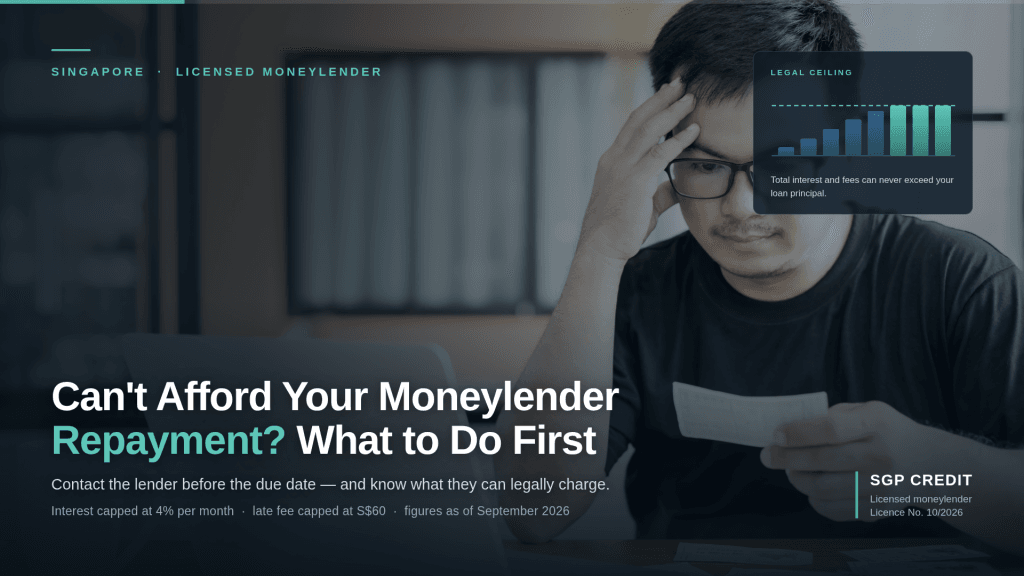
If you cannot make this month’s repayment to a licensed moneylender, contact the lender before the due date, ask for a statement of account, and check the payment dates in your Note of Contract. What a licensed moneylender may charge you is capped by law, and those caps do not change because you have fallen behind. What should I do first if I can’t afford my moneylender repayment this month? Contact the licensed moneylender before the due date and tell them what you are able to pay. Ask for a statement of account so you know the exact outstanding balance. Do not take a new loan to cover the old one. Interest and fees charged by licensed moneylenders in Singapore are capped by law, as of September 2026, so the amount owed cannot grow without limit. A workable order: Contact the lender before the due date. The conversation is easier before a payment is missed than after. Ask for a statement of account. You cannot negotiate a figure you do not know. Work out what you can realistically pay after rent, food, utilities and transport. Get any revised arrangement in writing. Stop taking new loans. A second lender is where most repayment problems become unmanageable. What counts as “late” — does being one day late trigger late interest and the late fee? Singapore’s moneylending rules do not set a general statutory grace period. Under the Moneylenders Rules, a licensed moneylender may charge late interest only on an amount that has already fallen due and remains unpaid. Once a payment is overdue, late interest of up to 4% per month may apply to it, and a late fee of up to S$60 for each month of late repayment may apply, as of September 2026. Your Note of Contract sets the payment dates. How do I get a statement showing exactly how much I still owe right now? Licensed moneylenders in Singapore must give you a copy of the Note of Contract, issue a receipt for every repayment, and provide a statement of account at least once every January and July, as of September 2026. If you do not know your balance, ask for a statement in writing before discussing any change to your payments. How much can a licensed moneylender legally charge me in late fees and late interest? As of September 2026, a licensed moneylender in Singapore may charge interest of at most 4% per month, late interest of at most 4% per month, a late fee of at most S$60 for each month of late repayment, and an administrative fee of at most 10% of the principal when the loan is granted. Court-ordered legal costs may be imposed where recovery through the courts succeeds. Nothing else may be charged. Charge Legal maximum (as of September 2026) What it applies to Notes Interest 4% per month The principal outstanding each month Calculated after payments appropriated to principal are deducted Late interest 4% per month Only the amount that has fallen due and is unpaid Cannot be charged on instalments not yet due Late fee S$60 Each month of late repayment Per month late, not per day Administrative fee 10% of principal Charged once, when the loan is granted Not a recurring charge Legal costs As ordered by the court Successful recovery action The only other permitted charge Overall ceiling: total interest + late interest + administrative fee + late fees can never exceed the principal amount of the loan. These limits come from the Moneylenders Act and the Moneylenders Rules, and are published by the Registry of Moneylenders, Ministry of Law. Is late interest charged on my whole outstanding loan, or only on the instalment I missed? Late interest may be charged only on the amount that has fallen due and remains unpaid. A licensed moneylender in Singapore cannot charge late interest on the part of your loan that is not yet due. Miss one instalment on a twelve-month loan and late interest applies to that instalment, not to the full outstanding balance. Is there a limit to how much my debt can grow if I keep missing payments? Yes. The total of interest, late interest, the administrative fee and late fees charged by a licensed moneylender can never exceed the principal amount of the loan, as of September 2026. On a S$3,000 loan, those charges cannot exceed S$3,000 in total, however long the loan runs. Court-ordered legal costs sit outside that ceiling. Can I negotiate or restructure my repayment plan with a licensed moneylender in Singapore? You can ask. A licensed moneylender is not required to agree, and any revised arrangement is subject to the lender’s assessment of your income, existing loans and repayment ability. Contact the lender early, explain what changed, and say what you can pay, with your statement of account and proof of current income in hand. Nothing obliges a lender to waive charges already incurred — what is worth asking about is the shape of the remaining repayments. If I extend my loan tenure to lower my monthly instalment, do I pay more in total? Usually yes. A longer tenure lowers the monthly instalment but leaves principal outstanding for longer, and interest is charged on the principal outstanding each month. The illustration below uses a S$3,000 loan at the 4% monthly cap, reducing balance, equal monthly instalments, no late payments. Tenure Monthly instalment Total repaid Total interest 6 months S$572.29 S$3,433.71 S$433.71 12 months S$319.66 S$3,835.88 S$835.88 Doubling the tenure cuts the instalment by about S$253 a month and adds about S$402 in interest. This is an illustration; your figures depend on your contract, loan amount, quoted rate and any administrative fee. If the shorter tenure is why you are missing payments, the longer one may still be the better choice — make it knowing the cost. What actually happens if I miss or default on a licensed moneylender loan? Late interest and a late fee may be charged within the legal caps, and