
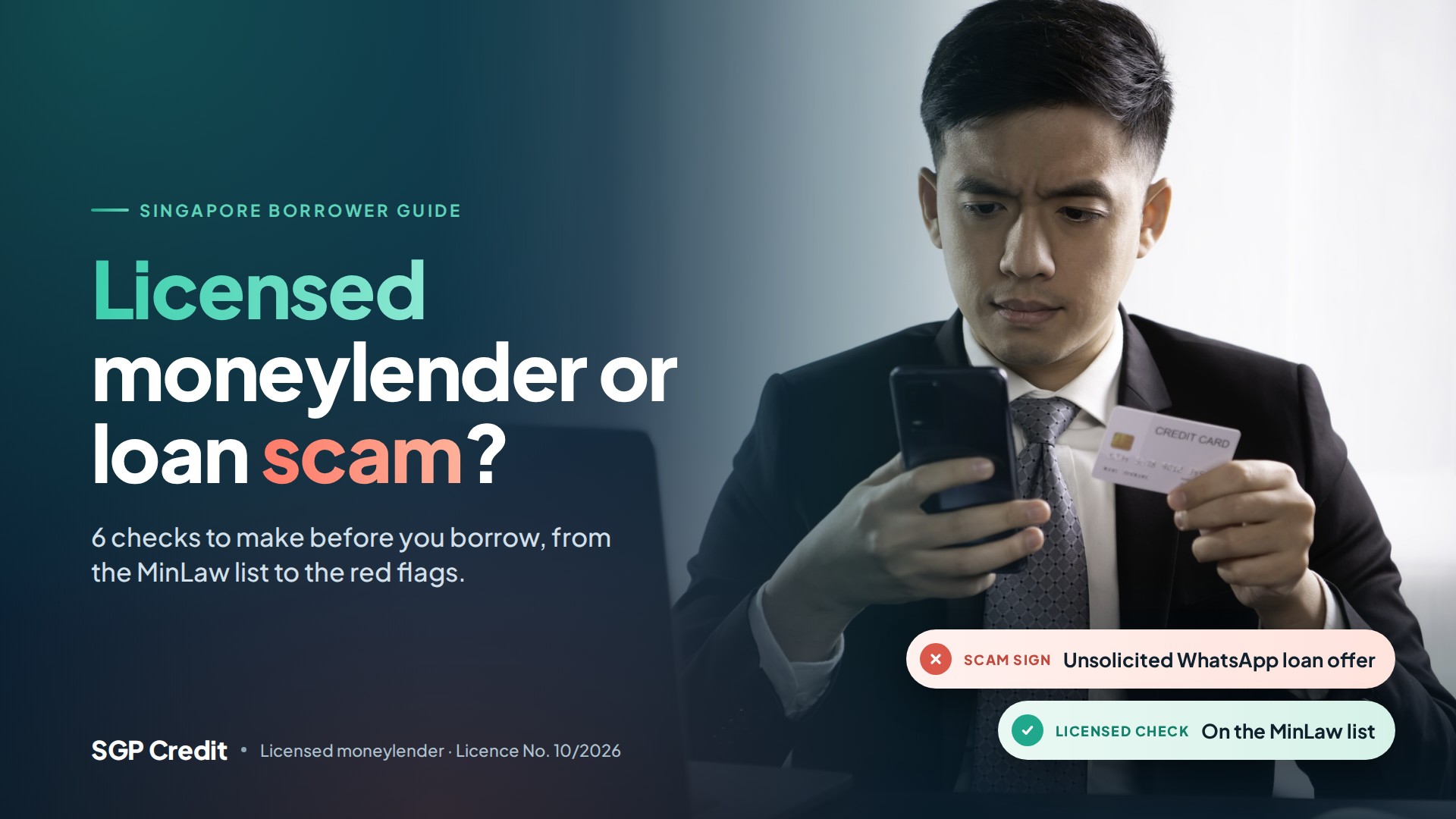
A loan offer that lands on WhatsApp when money is tight can feel like help has arrived. It can also be the start of a scam. The Registry of Moneylenders warns that scammers impersonate licensed moneylenders over SMS and WhatsApp, so a company name you recognise proves very little on its own.
To check if a moneylender in Singapore is licensed, look it up on the Ministry of Law’s List of Licensed Moneylenders and confirm that the business name, licence number, address, phone number and website all match. Then watch how the lender behaves. Licensed moneylenders must follow strict rules on advertising, fees and your personal documents, and a lender that breaks those rules is a warning sign.
This guide sets out six checks to make before you borrow. It then explains what a licensed moneylender can legally charge, and what to do if you are struggling to repay or have already been scammed.
Licensed moneylender or Ah Long: why the difference matters
A licensed moneylender in Singapore holds a licence from the Registry of Moneylenders, Ministry of Law (MinLaw), and must follow the Moneylenders Act and Rules. Those rules cap the interest, fees, and amounts a licensed moneylender can lend. They also set out how the lender must treat you, from explaining the contract to recovering a debt.
An Ah Long is an unlicensed moneylender. The Singapore Police Force notes that unlicensed moneylenders are also known as “loansharks” or “Ah Longs”. An Ah Long works outside the licensing system that sets those caps and protections. As of September 2026, unlicensed moneylending can be reported on the Police Hotline at 1800-255-0000.
6 checks to make before you borrow
Run through these six checks before you share any documents or sign anything. Each one is based on rules set by the Registry of Moneylenders or guidance from the Singapore Police Force and ScamShield.
1. Find the lender on MinLaw’s list
Start with the List of Licensed Moneylenders, published by the Registry of Moneylenders. As of September 2026, the list shows each licensed moneylender’s business name, licence number, address, telephone number and website. It was last updated on 23 September 2026. If you cannot find the business on the list, stop there.
2. Match every detail, not just the name
Because scammers use the names of real companies, a matching name is not enough. Compare the licence number, address, phone number, and website with the list exactly. If the name matches but the phone number is different, treat it as a warning sign. Call the number shown on the Registry’s list, not the one that contacted you.
3. Notice how the lender reached you
Licensed moneylenders in Singapore can advertise in only a few places. As of September 2026, the Registrar’s Directions on advertising (Version 3.0, effective 1 April 2025) allow three channels: business or consumer directories in print or online, the lender’s own website, and inside or on the exterior of its approved place of business.
Promotional advertising by SMS, WhatsApp, WeChat, email, and on social media such as Facebook is prohibited. The Singapore Police Force also names Telegram, TikTok and Instagram. A licensed moneylender may still contact its existing customers about outstanding loans, but a loan offer you never asked for is a red flag, whatever name it carries.
4. Never transfer money before the loan is paid out
A licensed moneylender in Singapore will not ask you to transfer money before the loan is disbursed. Scammers often call this payment a “GST fee” or a “processing fee”, and both the Singapore Police Force and the Registry of Moneylenders warn about it.
This is different from the administrative fee a licensed moneylender may charge. As of September 2026, that fee is capped at 10% of the principal, charged when the loan is granted, and can be deducted from the principal. It is never a separate payment you have to make first.
5. Keep your Singpass, NRIC and ATM card to yourself
Licensed moneylenders are not allowed to ask for your Singpass user ID or password, or to obtain information containing your account passwords. ScamShield also advises never sharing a one-time password (OTP) with anyone.
The same caution applies to your documents and cards. A licensed moneylender should not keep your NRIC or other identity documents, and the Registry of Moneylenders lists keeping a borrower’s ATM card among the practices to watch out for.
6. Don’t sign until you understand the contract
The Registry of Moneylenders advises borrowers not to rush into a loan and never to sign a blank or incomplete Note of Contract. A licensed moneylender must explain the loan terms in a language you understand and give you a copy of the Note of Contract.
After you sign, the lender must issue a receipt for every repayment and send you a statement of account at least once every January and July (as of September 2026). Unsecured loans other than business loans, disbursed on or after 15 September 2026, also come with a three-business-day cooling-off period. The FAQ below explains how it works.
Red flags at a glance
- A loan offer you didn’t ask for, by SMS, WhatsApp, Telegram or social media
- A “GST fee” or “processing fee” to pay before disbursement
- A request for your Singpass user ID, password, or OTP
- A lender keeping your NRIC or ATM card
- Pressure to sign, or a blank or incomplete Note of Contract
Know the legal limits on interest and fees
Knowing the legal caps gives you one more way to spot a problem. As of September 2026, a licensed moneylender in Singapore can charge at most 4% interest per month, calculated on the principal still owed, regardless of your income and whether the loan is secured or unsecured. A quote above the caps below should make you stop and check.
| Charge | Legal maximum (as of September 2026) |
|---|---|
| Interest | 4% per month, on the principal remaining after repayments |
| Late interest | 4% per month, only on the amount repaid late |
| Late fee | S$60 for each month of late repayment |
| Administrative fee | 10% of the principal, when the loan is granted |
| Legal costs | Only as ordered by a court |
| Interest + late interest + administrative fee + late fees | Cannot exceed the principal |
Late interest applies only to the overdue amount, not to instalments that are not yet due. Late interest and late fees both count towards the total cap, while court-ordered legal costs sit outside it. The rate you are quoted depends on the lender’s assessment.
How much you can borrow
As of September 2026, unsecured borrowing limits apply across all licensed moneylenders combined, not per lender. Before granting a loan, a licensed moneylender must submit your borrower and loan information to the Moneylenders Credit Bureau (MLCB), which is how the combined limit is checked.
| Annual income | Citizens and PRs | Foreigners residing in Singapore |
|---|---|---|
| Below S$10,000 | S$3,000 | S$500 |
| S$10,000 to below S$20,000 | S$3,000 | S$3,000 |
| S$20,000 and above | 6 × monthly income | 6 × monthly income |
Secured loans have no legal cap on the amount. Approval is subject to the lender’s assessment of your income, existing loans, and repayment ability.
What a S$3,000 loan could cost
Because interest and fees together can never exceed the principal, the most you could owe on a S$3,000 loan from a licensed moneylender is S$6,000, plus any court-ordered legal costs (as of September 2026). A loan repaid on schedule stays well below that ceiling, as this illustration shows: S$3,000 repaid over 6 months, with S$500 of principal each month and the legal maximum of 4% per month on the principal still owed.
| Month | Principal owed | Interest (4%) | Instalment |
|---|---|---|---|
| 1 | S$3,000 | S$120 | S$620 |
| 2 | S$2,500 | S$100 | S$600 |
| 3 | S$2,000 | S$80 | S$580 |
| 4 | S$1,500 | S$60 | S$560 |
| 5 | S$1,000 | S$40 | S$540 |
| 6 | S$500 | S$20 | S$520 |
| Total | S$420 | S$3,420 |
Add the maximum 10% administrative fee (S$300), and total charges come to S$720, or S$3,720 altogether. Late payments would add late charges, but interest and fees together would still stop at S$3,000.
This illustration uses legal maximums and is not a quote. Your rate, fees, and schedule depend on the lender’s assessment and your contract.
If you are struggling to repay
Missing a repayment to a licensed moneylender in Singapore brings late interest and late fees, but all of those charges together still cannot exceed the principal. If you can see a missed payment coming, talk to the lender early. You can negotiate directly, or through a lawyer or a social service agency. The Registry of Moneylenders cannot negotiate or restructure the loan for you.
How debt recovery must work
A licensed moneylender may take reasonable steps to recover a debt, including approaching you at home or at work, although workplace visits are treated as a more intrusive method. It must not harass, threaten, or use violence. Debt-recovery calls and texts should go to you, not to third parties, and must not be excessive. You can report misconduct to the Registry of Moneylenders on 1800-2255-529.
Where to get help
The Registry of Moneylenders lists seven organisations that provide debt counselling and support: Adullam Life Counselling, Association of Muslim Professionals (AMP), Arise2Care Community Services, Blessed Grace Social Services, Credit Counselling Singapore (which also handles cases involving bank debts), One Hope Centre and Silver Lining Community Services. Contact details are on the Registry’s borrower FAQ page.
If you want to stop yourself from borrowing more, you can register for the MLCB self-exclusion scheme. As of September 2026, Citizens and PRs choose a minimum period of 1 or 2 years, and foreigners have a default minimum of 2 years. During that time, licensed moneylenders cannot grant you a new unsecured loan, except a debt consolidation loan. The scheme is voluntary, so you generally cannot use it to stop an eligible family member from borrowing; only they can register.
If you have already been scammed
If a fake moneylender in Singapore has taken your money or your details, ScamShield’s guidance sets out four steps:
- Contact your bank immediately.
- File a police report.
- Secure your accounts.
- Report the scammer to the platform where you were contacted.
As of September 2026, the ScamShield Helpline is 1799, the Police Hotline is 1800-255-0000, and 999 is for urgent police assistance.
Before you borrow
Borrow only what you need and can repay on schedule. Before you sign, check the total you will repay, not just the monthly instalment. If you are already struggling with existing loans, speak to one of the debt counselling organisations above before taking on new debt.
About SGP Credit
SGP CREDIT SINGAPORE PTE. LTD. Licensed by the Ministry of Law’s Registrar of Moneylenders (Licence No. 10/2026) Blk 133 Jurong Gateway Road, #01-295, Singapore 600133 Tel: +65 6466 1157 · www.sgpcredit.com.sg
You can verify our licence, or any moneylender’s, on the Ministry of Law’s List of Licensed Moneylenders. For questions about a personal loan, call us or visit our Jurong East office. Approval is subject to our assessment of your income, existing loans and repayment ability.
Frequently asked questions
Why would a moneylender ask for my Singpass login or OTP?
Licensed moneylenders in Singapore are not allowed to ask for your Singpass user ID or password, or to obtain information containing your account passwords. ScamShield also advises never sharing a one-time password (OTP) with anyone. If a lender asks for either, stop and check the lender on MinLaw’s list.
Can a moneylender keep my NRIC or bank card?
Licensed moneylenders in Singapore should not keep your NRIC or other identity documents. The Registry of Moneylenders also lists keeping a borrower’s ATM card among the practices to watch out for. If a lender asks to hold either, treat it as a warning sign and report it to the Registry on 1800-2255-529.
Does my loan show up on the Moneylenders Credit Bureau (MLCB)?
Yes. Before granting a loan, a licensed moneylender in Singapore must submit your borrower and loan information to the Moneylenders Credit Bureau (MLCB). MLCB reports include active loans and pending loan applications, which is how the borrowing limit across all licensed moneylenders is checked. For details of your own report, ask the MLCB.
Is a licensed moneylender the same as a bank?
No. A licensed moneylender in Singapore is not a bank. Licensed moneylenders are regulated by the Registry of Moneylenders at the Ministry of Law (MinLaw) under the Moneylenders Act, which sets the borrowing limits. Moneylender loans are checked against the Moneylenders Credit Bureau (MLCB), while Credit Bureau Singapore (CBS) serves the banking side.
Is there a cooling-off period if I change my mind?
Yes, for unsecured loans other than business loans disbursed on or after 15 September 2026. As of September 2026, you can cancel within three business days, not counting the day the loan is paid out. No interest is charged, you repay no more than the principal, and the lender may keep only a limited portion of the loan approval fee.
Sources
- Registry of Moneylenders: FAQs on Borrowing From Licensed Moneylenders
- Registry of Moneylenders: List of Licensed Moneylenders
- Singapore Police Force: Unlicensed Moneylending
- ScamShield: I’ve been scammed
- Moneylenders Act 2008, Singapore Statutes Online
- Registrar’s Directions on Advertising and Marketing Activities (Version 3.0, effective 1 April 2025)
