
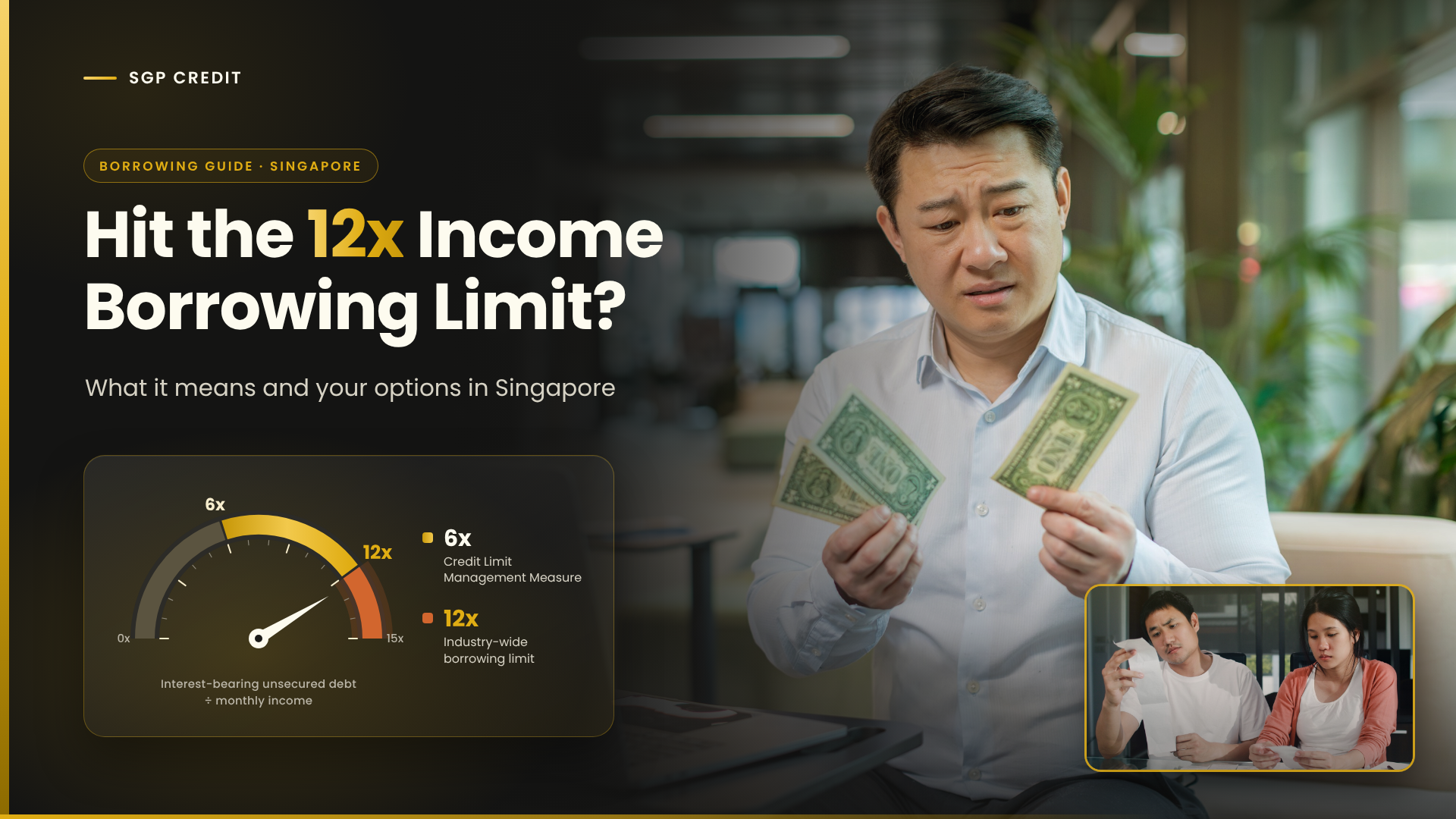
A card that suddenly stops working, or a declined limit increase, rarely comes with an explanation. Often the reason is Singapore’s 12x rule, a bank rule set by the Monetary Authority of Singapore (MAS) that compares your interest-bearing unsecured debt with your income. Below, we look at how it works, what you can do, and where licensed moneylenders, who follow separate Ministry of Law caps, fit in.
What is the 12x income borrowing limit in Singapore?
As of October 2026, Singapore’s 12x income borrowing limit applies when a borrower’s interest-bearing unsecured debt across all financial institutions exceeds 12 times monthly income for three consecutive months. Once that happens, banks and card issuers cannot allow new charges, new unsecured facilities or limit increases, and the borrower’s existing unsecured facilities are suspended.
MAS phased the limit in at 24 times monthly income from 1 June 2015, 18 times from 1 June 2017 and 12 times from 1 June 2019. As of October 2026, borrowers with annual income of at least S$120,000, or net personal assets above S$2 million, are exempt.
Which debts count towards the 12x limit?
The 12x limit in Singapore counts interest-bearing unsecured debt: credit card balances rolled over, interest-bearing unsecured loans and overdrafts. It does not count card spending repaid in full by the due date, interest-free instalments with no interest imposed, or secured housing and motor vehicle loans. Specified needs-based loans, including medical, education and business loans, are treated differently.
Why was my credit card suspended when I’ve never missed a payment?
As of October 2026, a credit card in Singapore can be suspended under the 12x rule even when every payment is on time. The rule compares your interest-bearing unsecured debt with your income, not your payment record. If those balances stay above 12 times your monthly income for three consecutive months, your existing unsecured facilities are suspended.
Paying only the minimum can leave a large interest-bearing balance in place. Income matters too. Banks can count salaries, bonuses, dividends, interest and rental income, each using its own records and methods, so a drop in commission or bonus can push your multiple up.
How is the 12x limit different from the 6x rule on new credit?
The 12x limit and the Credit Limit Management Measure are separate rules in Singapore. As of October 2026, the 12x limit suspends existing facilities once interest-bearing unsecured debt stays above 12x monthly income for three consecutive months. The Credit Limit Management Measure, in effect since 1 January 2018, restricts new facilities and limit increases when debt exceeds 6x monthly income and the new credit would take your total approved limit above 12x.
That explains an oddly low new limit, or an application declined below 12x. Crossing 6x alone does not block all new credit; the test is whether new credit would push your total approved limit past 12x. Existing facilities and limits are not automatically withdrawn or reduced.
The Association of Banks in Singapore (ABS) adds that under this measure a supplementary cardholder’s debt counts under the principal cardholder, joint balances are split equally and temporary limit increases are included. Closed cards drop out of your total limit, though credit reports may take time to update.
Three borrowing limits compared (as of October 2026)
| Bank 12x borrowing limit | Credit Limit Management Measure | Licensed moneylender cap | |
|---|---|---|---|
| Set by | MAS, for banks and card issuers | MAS, for banks and card issuers | Registry of Moneylenders, Ministry of Law, under the Moneylenders Act |
| In effect | At 12x since 1 June 2019 | Since 1 January 2018 | — |
| What is measured | Interest-bearing unsecured debt across all financial institutions | Unsecured debt and total approved credit limit | Total unsecured loans across all licensed moneylenders |
| Threshold | Debt above 12x monthly income for 3 consecutive months | Debt above 6x monthly income, and new credit would take total limit above 12x | 6x monthly income at annual income of S$20,000 or more. Below S$20,000: S$3,000 for Citizens/PRs; for foreigners, S$500 below S$10,000 and S$3,000 from S$10,000 to below S$20,000 |
| Grace period | 3 consecutive months | None | Not applicable |
| Existing facilities | Suspended | Not automatically withdrawn or reduced | Not applicable |
| Exemptions | Annual income of at least S$120,000, or net personal assets above S$2 million | Foreigners; annual income of at least S$120,000; net personal assets above S$2 million; needs-based loans treated separately | Secured loans have no cap |
| Credit bureau | Credit Bureau Singapore (CBS) | Credit Bureau Singapore (CBS) | Moneylenders Credit Bureau (MLCB) |
| How access returns | Debt below 12x, plus fresh credit bureau and income checks | Debt below 6x or total limit below 12x, subject to assessment | Not applicable |
How do I check where I stand before I apply for anything?
You can check your position against Singapore’s 12x limit by adding up the interest-bearing unsecured balances on your Credit Bureau Singapore (CBS) report and recent statements, then comparing the total with 12 times monthly income, the threshold as of October 2026. Licensed moneylender loans sit separately on the Moneylenders Credit Bureau (MLCB) Loan Information Report, which does not include bank facilities.
A worked example (hypothetical, not a real borrower or a lending decision)
A borrower earning S$4,500 a month has bank thresholds of S$54,000 (12x) and S$27,000 (6x). They carry S$14,000 rolled over on one card and S$22,000 on an interest-bearing bank personal loan. Spending repaid in full by the due date, an interest-free instalment plan with no interest imposed and a secured car loan do not count, so counted debt is S$36,000, or 8x.
At 8x their cards keep working. But because their debt is above 6x, the 2018 measure applies: with a total approved limit of S$50,000, a S$5,000 increase would take it to S$55,000, above S$54,000, so it would be restricted. If the card balance grew to S$34,000, counted debt would reach S$56,000, about 12.4x. Three consecutive months at that level would mean suspension.
Separately, as of October 2026, licensed moneylenders combined could lend them at most S$27,000 unsecured: 6x monthly income, because their annual income of S$54,000 is above S$20,000. That is a ceiling, not an entitlement.
How do I get back under the 12x limit?
As of October 2026, getting back under Singapore’s 12x limit means bringing interest-bearing unsecured debt below 12 times your monthly income. The main routes are a repayment or restructuring arrangement, which banks may offer depending on their own criteria and terms; the banks’ Debt Consolidation Plan (DCP) if you qualify; or a debt-help organisation.
As of October 2026, the DCP generally requires Citizen or PR status, annual income from S$20,000 to below S$120,000, net personal assets below S$2 million and interest-bearing unsecured debt above 12x monthly income, with approval subject to the institution’s assessment. Commission and self-employed earners are not excluded as a group; accepted income evidence varies. Balances move in full to one institution, old facilities are closed or suspended, and you get a 1x monthly income revolving facility. Joint-account debts, renovation, education and medical loans, business facilities and licensed moneylender loans stay outside it.
The Registry of Moneylenders also lists debt-help organisations in its borrower FAQ. One of them, Credit Counselling Singapore (CCS), handles cases involving bank debts; as of October 2026, it charges a non-refundable S$50 to S$250 fee when it submits a Debt Management Programme proposal to your creditors.
Can a licensed moneylender still lend to me if I’ve hit the 12x limit, and should I?
A licensed moneylender in Singapore may still be able to lend to someone over the bank 12x limit, because the two are separate frameworks. Licensed moneylenders are regulated by the Registry of Moneylenders, Ministry of Law, not MAS. Any loan must fit the aggregate unsecured cap and your MLCB self-exclusion status, and approval is subject to the lender’s assessment of your income, existing loans and repayment ability.
Costs are capped by law. As of October 2026, interest is capped at 4% per month on the remaining principal, and late interest at 4% per month on the amount repaid late only. The late fee is at most S$60 for each month of late repayment, the administrative fee at most 10% of principal, and total charges can never exceed the principal. Court-ordered legal costs are the only other permitted charge.
You should receive a Note of Contract explained in a language you understand, a receipt for each repayment and statements at least every January and July, and no licensed moneylender may keep your NRIC or ask for your SingPass login. Qualifying unsecured, non-business loans disbursed on or after 15 September 2026 also carry a three-business-day cooling-off period.
When should you not take a moneylender loan?
You should not take a licensed moneylender loan to cover card minimum payments with no plan to clear the balances, or if instalments would squeeze essentials such as rent and food. Because the DCP excludes licensed moneylender loans, a new one would also sit outside any later bank consolidation.
If you tend to over-borrow, MLCB’s voluntary self-exclusion stops licensed moneylenders granting you unsecured loans other than debt consolidation loans; as of October 2026, the minimum period is one or two years for Citizens and PRs and two years for foreigners. Licensed moneylenders cannot advertise by SMS, so report any SMS loan offer to the X-Ah-Long hotline on 1800-924-5664.
How long until my credit cards are reinstated?
The 12x rule in Singapore ties reinstatement to conditions, not a date. As of October 2026, suspended unsecured facilities can be reinstated only after your interest-bearing unsecured debt falls below 12 times your monthly income and the bank completes fresh credit bureau and income checks.
After a DCP, as of October 2026, you can seek new unsecured credit from another institution at or below 8x monthly income and from your DCP institution below 4x (S$36,000 and S$18,000 in the worked example). The plan stays on your credit bureau report under a “Debt Consolidation” code for three years after it closes.
Borrowing responsibly: Borrow only what your current income can repay after essentials, and read the Note of Contract before you sign. If repayments are already a struggle, speak to a debt-help organisation before taking on any new loan.
What else do people ask about the 12x limit?
If I’m 60 days late with one bank, will my other banks suspend my cards too?
Not automatically. Under MAS’s separate 60-day past-due rule, the overdue bank cannot grant you further unsecured credit, and other banks cannot raise your limits or issue new cards or unsecured facilities. Your existing facilities with other banks are not suspended just because you are overdue elsewhere.
Does being over 12x stop me getting an HDB loan, bank home loan or car loan?
Not by itself. Secured housing and motor vehicle loans sit outside the 12x calculation, so the rule is not a blanket ban on home or car loans in Singapore. Approval still depends on separate checks, including MAS’s Total Debt Servicing Ratio and Mortgage Servicing Ratio frameworks and HDB’s own guidance.
Do licensed moneylender loans count towards the bank 12x limit?
Licensed moneylender loans and the bank 12x limit sit in separate frameworks in Singapore. The 12x limit covers interest-bearing unsecured debt across financial institutions, checked through Credit Bureau Singapore. Licensed moneylender loans are recorded by the Moneylenders Credit Bureau, which does not collect bank data, and count towards the Ministry of Law’s cap.
Does the 12x limit apply to foreigners on a work pass?
Foreigners are expressly exempt from Singapore’s 2018 Credit Limit Management Measure; ask your bank how the 12x limit applies to you. As of October 2026, licensed moneylenders cap unsecured loans to foreigners residing in Singapore at S$500 below S$10,000 annual income, S$3,000 from S$10,000 to below S$20,000, and 6x monthly income at S$20,000 or more.
Is a debt consolidation loan cheaper than keeping balances on several cards?
It depends on the rates you are offered, which vary by institution and product, so compare total costs, including fees, before switching. As of October 2026, licensed moneylenders in Singapore can charge at most 4% interest per month and a 10% administrative fee, with total charges capped at the principal.
SGP CREDIT SINGAPORE PTE. LTD. is licensed by the Ministry of Law’s Registrar of Moneylenders (Licence No. 10/2026). If you are considering a personal loan from a licensed moneylender, approval is subject to the lender’s assessment of your income, existing loans, and repayment ability. You can verify any moneylender’s licence on the Ministry of Law’s list of licensed moneylenders.
133, JURONG GATEWAY ROAD, #01-295, SINGAPORE 600133 · Tel: 64661157
Sources
- Registry of Moneylenders, Ministry of Law — FAQs on Borrowing From Licensed Moneylenders
- Registry of Moneylenders, Ministry of Law — List of licensed moneylenders in Singapore
- Monetary Authority of Singapore — Borrowing limit on unsecured credit
- Monetary Authority of Singapore — Rules for borrowers who are 60 days past due
- Monetary Authority of Singapore — Credit Limit Management Measure
- Association of Banks in Singapore — Debt Consolidation Plan
- Association of Banks in Singapore — FAQs on the Credit Limit Management Measure
- Credit Counselling Singapore — Appointment and documents
- Credit Counselling Singapore — Understanding your Loan Information Report
- Moneylenders Credit Bureau · Credit Bureau Singapore
